
Add Your Heading Text Here

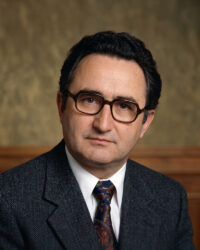
He was born into a farming family of many children in 1928 in Brzeznica. He lived with his parents in Przysieki near Bochnia until 1942. At the age of 14, he was expatriated to work camps in Germany, which began his fate as a wanderer. After three years of slave work in Germany, when the American Army liberated the town where he worked in 1945, young Julian found himself in Lahde, Westfalia, in a Polish Rally Centre. He stayed there until 1949; during that time, he studied and worked, married Weronika Horbacewicz, and fathered his first daughter Aleksandra.
In Lahde, he organized a scouting troop, led the “Zawisz Czarnego” male troop for two years, belonged to the church choir and an amateur theatre group, and worked at the YMCA and Caritas. In 1949, he immigrated to Brazil with his family. After many years of clearing land of wild jungle, the Dobranowski family moved to Sao Paolo. After completing accounting studies at the Instituto Universal Brasileiro, Julian began working as the head accountant in the metallurgical industry.
He also studied business law and administration at the Instituto Superior de Preparacao Tecnica. Inability to adapt to the climatic conditions forced the Dobranowskis to leave Brazil in 1957. Canada became their new homeland: they settled in Oshawa and, as of 1969, lived in Whitby.
Between 1960 and 1973, Julian Dobranowski worked at the General Motors car manufacturing plant and, later, resumed accounting at his own office of accounting services and financial advice. At the same time, he became an active volunteer in the Polish community. He joined St. Hedwig’s Choir in Oshawa, participated in scouting, and directed a few camps in the Kaszubian region. As a deputy scouting master of the Polish Scouting Association, he became the tribe-leader of the coeducational “Podhale” tribe, which earned its fame at a Kaszubian performance of the Polish harvest festival, during Polish Millennium celebrations. Julian Dobranowski joined PAC Branch 21 in Oshawa in 1960. As a delegate of the branch, he participated in several PAC General Assemblies, at which he was often secretary or chairperson.
At the XXIV PAC General Assembly in Hamilton in 1969, the decision was made to create a foundation. This task was given to the newly-elected Vice-president of the Head Executive Board, Julian Dobranowski. In 1965, he headed the Organizational Committee that would convert the existing Scholarship Fund into a Foundation. The W. Reymont Foundation was officially established on September 17, 1970, and Julian Dobranowski was its first President for 5 years.
He initiated the building of a culturally-educational Canada-Poland “bridge” via the organization of Polish folkloric and cultural courses for Polish-Canadian youth at all Polish universities. At the XXX PAC General Assembly in October 1981, Julian Dobranowski was elected President of the Alliance’s Head Executive Board, in honour of his thirty-year work for the Polish community in Canada.
His presidency of the PAC Head Executive Board lasted two terms until 1985. This was a period of intensive work to help thousands of Poles who found themselves in refugee camps in Western Europe after 1981.
The Head Executive Board petitioned for financial help from the Federal Government of Canada. Julian Dobranowski’s efforts, with distinguished help from Polish envoy to Parliament Jesse Flis, were successful: an agreement was signed that gave the Alliance the right to form the Committee for Refugee Affairs. This committee played an enormous part in organizing help for thousands of refugees.
1982 was the PAC’s Diamond Jubilee and was filled with the organization of various activities. Thanks to President Dobranowski’s contacts with the Ontario government, the Alliance received financial support to organize jubilee festivities, which included the publication of the memory book entitled Diamond Jubilee of The Polish Alliance of Canada – 1907-1982.
After a short illness, Julian Dobranowski died suddenly, leaving his family and the entire Polish community in deep mourning. Author Franciszek Kmietowicz remembered Julian Dobranowski in The Alliancer, writing the following:
“If a painter wanted to properly portray the deceased, the paint would be too pale. Because Julian repeatedly surpassed the average. He was able to achieve twice as much as he promised. He was always smiling and eager to work. He increased himself twofold and threefold. He spared neither time nor energy. He was a candle that burned from both ends. […]”